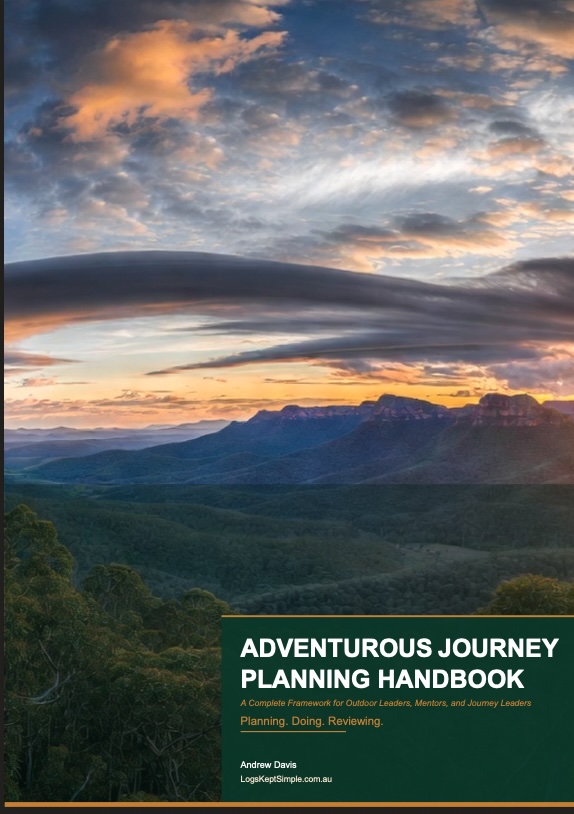
Planning an adventurous journey for a youth group involves a lot more paperwork, a lot more conversations, and a lot more decisions than most people expect the first time they do it. The approval frameworks required by organisations like Scouts Australia, the Duke of Edinburgh Award, and similar programs exist for good reasons. They are not always well explained to the leaders and advisers who have to work through them.
The Adventurous Journey Planning Handbook is a practical guide to that whole process. It is not a theoretical document. It came from years of planning and leading journeys and watching the same gaps appear every time, across different groups, different routes, and different approval bodies.
What is actually in it
The handbook covers the pre-trip planning arc from start to finish. Not as a checklist you fill in and forget, but as a proper working framework for the decisions you are going to have to make.
- Route selection: how to assess a route for a specific group rather than in the abstract, and why the right route for your most capable participant is usually the wrong route for the group
- Weather thresholds: setting them before the trip rather than making on-the-spot calls under pressure when you are tired and the group is waiting
- Risk assessment frameworks that reflect what actually happens in the field rather than satisfying a form for its own sake
- Timing gates and how to use them to make turnaround decisions without second-guessing yourself at the time
- Group briefing checklists so participants know what to do before they need to do it
- Approval documentation frameworks that match what assessors are actually looking for
Who it is for
The handbook is most useful for leaders, advisers, and teachers who are responsible for planning or approving adventurous journeys. It is the reference you want when you are sitting down to fill in a risk assessment or plan a multi-day route and you are not quite sure what the assessor is actually looking at.
It is also useful for experienced participants who are planning their own qualifying journeys and want a structured approach rather than starting from a blank page. The approval process for a self-reliant journey is more involved than most participants realise until they are partway through it.
The section most leaders find most useful
The timing gates section tends to get the most use. The concept of setting specific time-based decision points before the trip, rather than deciding in the field whether things are going well enough to continue, changes the way most leaders manage longer routes. A timing gate takes the emotion out of a turnaround call. You agreed before you left that if you had not reached point X by time Y, you turn around. When you hit that point in the field you just follow the plan rather than having a group conversation while everyone is tired and nobody wants to be the one who suggested stopping.
The weather threshold section
Weather decisions get made badly on the day more often than on any other planning dimension. The handbook gives a framework for setting specific thresholds during planning: wind speed, rainfall, temperature ranges, lightning distance. Written down before the trip, agreed by the group, known to the approval authority. When conditions on the day hit a threshold, the decision is already made. You are not weighing up whether it feels bad enough to cancel while the group is standing in the rain hoping you will say it is fine.
Getting a copy
The handbook is available as a free PDF download directly from the Logs Kept Simple website. There is also a physical copy on Amazon if you want something you can write in, tab, and take to planning meetings without opening a laptop. Most people download the PDF to read it first and then order the physical copy later.