
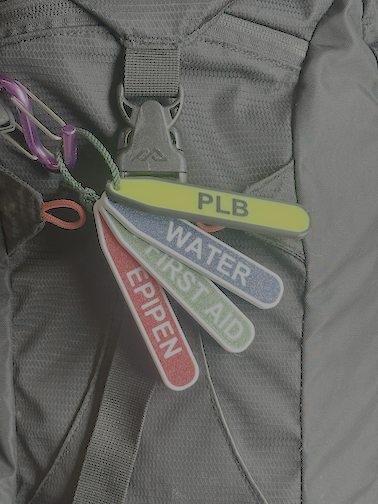
If someone in your group collapses on a remote track, who knows which pack has the PLB? If someone goes into anaphylaxis, can the nearest person find the EpiPen without opening every bag in the group?
These are not hypothetical questions. In a real emergency the first few minutes matter more than almost any other factor. Searching through multiple packs while someone is unresponsive is time you do not have. If the person who knew where the gear was is the one who is injured, the problem is worse.
What PackAlert tags actually are
PackAlert tags are physical, high-contrast labels that attach to the outside of backpacks. Each tag identifies what that pack is carrying: PLB, EPIRB, First Aid Kit, Snake Bandage, EpiPen, Water Supply, Rescue Gear. Anyone in the group or any first responder on scene can read them immediately. No asking, no searching, no guessing.
The labels are designed for outdoor conditions. High contrast so they are readable in fading light, rain, or when you are stressed and not reading carefully. They clip to pack straps and gear loops rather than requiring permanent attachment.
Why the design matters
A handwritten note on a piece of tape inside the lid pocket is not useful in an emergency. Neither is a verbal briefing at the start of a trip that most participants will not fully remember three days later. The whole point of the tags is that the information is on the outside of the pack, visible at a glance, in a format that works when conditions are not ideal.
Consider what happens when a first responder arrives at a group. They do not know who was carrying what. They cannot ask the person who is injured. With tagged packs, they can scan the group and identify the relevant gear in a few seconds.
Who should be using them
Any group leader who is carrying critical gear should have their pack labelled. If you are the PLB holder, your pack should say so clearly. If someone else in the group is responsible for the group first aid kit, that pack should be identifiable without having to ask.
Youth groups are a particularly strong use case. If the leader is the one who is injured, the other adults and older participants need to know where the critical gear is without being told. Tags remove that dependency entirely.
Search and rescue teams have noted that finding relevant gear quickly on scene is a consistent problem. Most groups carry good gear. The gear is often packed well. The problem is that nobody on scene other than the person who packed it knows where anything is.
The available tag types
- PLB: for personal locator beacons
- EPIRB: for emergency position-indicating radio beacons
- First Aid Kit: for the group medical kit
- Snake Bandage: for compression bandages used in snake and pressure immobilisation treatment
- EpiPen: for anaphylaxis management
- Water Supply: for group water reserves
- Rescue Gear: for ropes and technical equipment
- Custom tags with different wording or colour combinations are available for specific needs
Where to get them
Tags are available through the PackAlert store online. Custom orders can be arranged through sales@logskeptsimple.com.au. They are not expensive, they take seconds to attach, and once they are on the pack you stop thinking about it.
If you are running any kind of group outdoor activity, from a day walk to a multi-day expedition, the tags are worth having. The scenario where they matter is rare. When that scenario happens, they are the thing that makes a real difference.